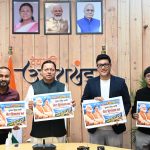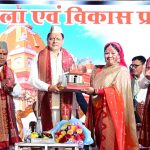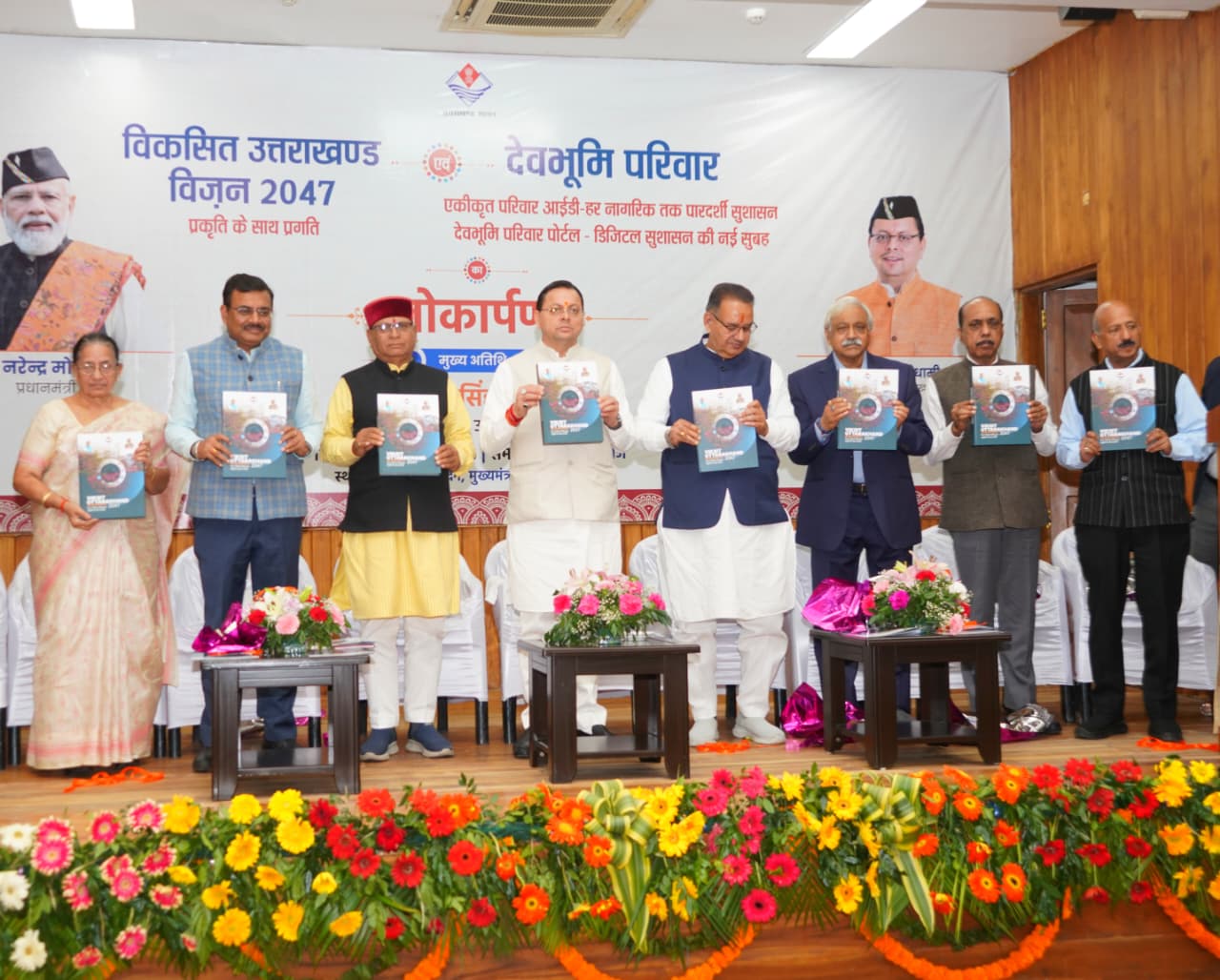
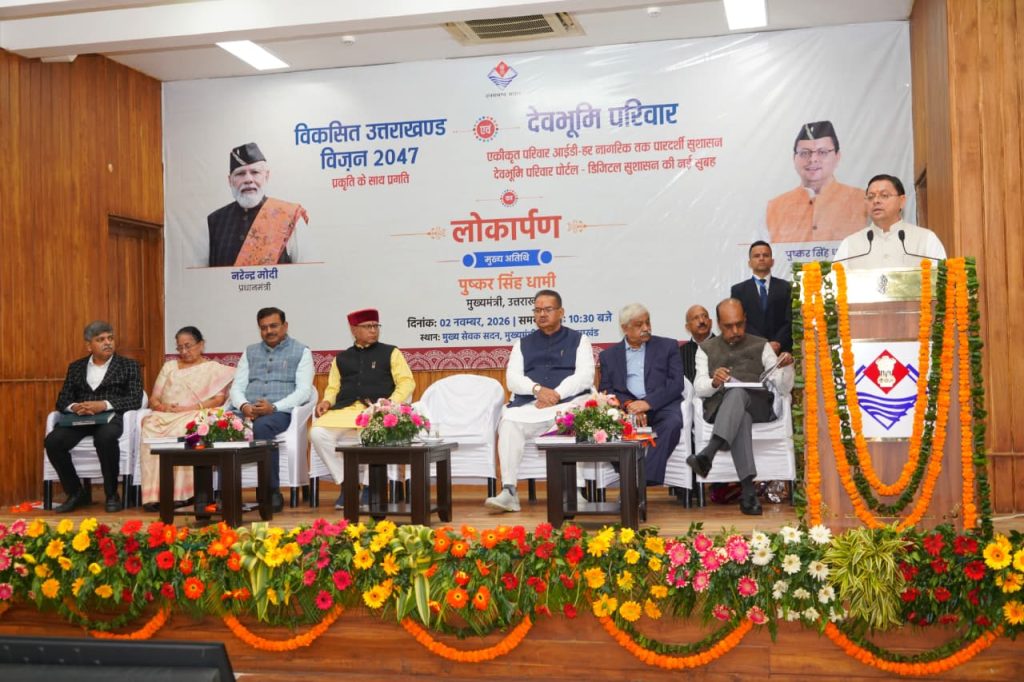
Chief Minister Pushkar Singh Dhami on Monday launched the ‘Devbhoomi Parivar Portal’ and unveiled the ‘Developed Uttarakhand Vision-2047’ at the Mukhya Sevak Sadan, located at the Chief Minister’s Camp Office.
The Chief Minister said both initiatives would play a significant role in strengthening good governance, ensuring that government welfare schemes reach eligible beneficiaries, and providing a clear roadmap for the state’s long-term development.
Emphasising the importance of effective public service delivery, Dhami said the success of any government should not be measured merely by the number of schemes launched, but by how effectively their benefits reach eligible citizens and improve their lives.
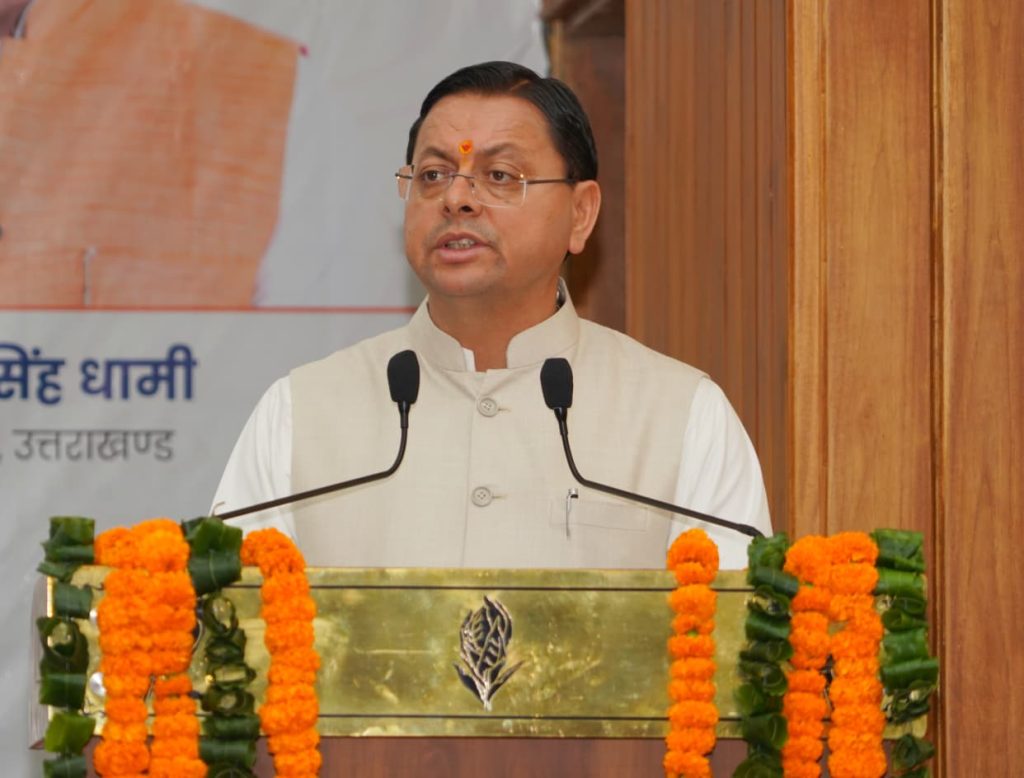
He pointed out that many eligible people are unable to access government schemes due to a lack of information, while citizens often have to submit the same documents repeatedly and visit multiple government departments to avail themselves of services.
The Devbhoomi Parivar Portal aims to address these challenges by making public services simpler, more transparent and citizen-centric.
Devbhoomi Parivar Portal to Create Unified Digital Family Database
Principal Secretary (Planning) Dr R. Meenakshi Sundaram said the primary objective of the Devbhoomi Parivar Portal is to develop an integrated digital database of families residing in Uttarakhand.
Through the portal, information about families and their members will be available on a unified platform. Following registration, each family will receive a unique ‘Devbhoomi Parivar ID’.
The system will help government departments identify eligible beneficiaries, improve coordination and ensure more effective implementation of welfare schemes.
It will also reduce the need for citizens to repeatedly submit documents and visit different government offices.
The portal is expected to facilitate scheme monitoring, assessment of beneficiary requirements and better planning of government budgets and resources.
For its effective implementation, the state government has proposed establishing a ‘Devbhoomi Parivar Authority’ at the state level and appointing District Devbhoomi Parivar Officers at the district level.
Vision-2047 Sets Ambitious Economic and Development Targets
Unveiling the Developed Uttarakhand Vision-2047, the Chief Minister described it as more than just a document outlining targets, calling it a comprehensive roadmap for the state’s overall development.
Dr Sundaram informed that the vision document identifies nearly 440 indicators to establish long-term development goals across various sectors.
The key targets set for 2047 include:
-
State economy: Expand Uttarakhand’s economy to approximately ₹28 lakh crore.
-
Per capita income: Increase per capita income to around ₹20 lakh.
-
Unemployment: Reduce the unemployment rate to 3.5 per cent.
-
Multidimensional poverty: Bring the rate down to 0.61 per cent.
-
Installed energy capacity: Increase it to approximately 22,000 MW.
-
Forest cover: Expand forest coverage to 46.6 per cent.
The vision document places special emphasis on agriculture, tourism, industries, education, healthcare, employment, skill development, connectivity and environmental conservation.
It also establishes intermediate development milestones for 2030, 2035, 2040, 2047 and 2050. Departments will be required to prepare action plans based on these targets and regularly review their progress.
Dhami directed officials and district administrations to formulate development strategies according to local requirements and ensure their timely implementation.
Infrastructure and Tourism Development to Drive Growth
The Chief Minister said Uttarakhand was steadily expanding its infrastructure and connectivity under the joint efforts of the Central and state governments.
He highlighted major infrastructure projects, including the Delhi-Dehradun Economic Corridor, the Rishikesh-Karnaprayag Rail Project and the Char Dham Road Project, saying these initiatives would significantly improve connectivity across the state.
He also referred to reconstruction and redevelopment works at Kedarnath and Badrinath, along with the Manaskhand Temple Mala Mission and other religious tourism projects.
The state government is also promoting winter tourism to encourage year-round tourist activities and strengthen the local economy.
Focus on Investment, Startups and Women’s Empowerment
Dhami said the government was making continuous efforts to promote industrial investment, self-employment and startups in Uttarakhand.
Through the ‘House of Himalayas’ initiative, locally produced goods are being connected with wider markets to strengthen the state’s traditional industries and local entrepreneurs.
Highlighting women’s empowerment initiatives, he said women have been provided 30 per cent horizontal reservation in government services.
Self-help groups and the Lakhpati Didi scheme are also playing an important role in strengthening women’s financial independence.
According to the Chief Minister, more than three lakh women in Uttarakhand have already become Lakhpati Didis.
Uttarakhand’s Economy Grows, GSDP Records 7.23% Growth
Highlighting the state’s economic performance, Dhami said Uttarakhand’s economy had grown more than one-and-a-half times.
The state’s Gross State Domestic Product (GSDP) recorded a growth of 7.23 per cent over the previous year.
He also highlighted a 41 per cent increase in per capita income and a 44 per cent rise in reverse migration, describing these developments as indicators of positive changes taking place in the state.
The government is also focusing on improving basic infrastructure, creating local employment opportunities and strengthening livelihood options in border and remote areas.
‘Development Must Go Hand in Hand with Nature’
Emphasising sustainable development, Dhami said Uttarakhand’s growth model must be based on the principle of ‘Progress with Nature’.
He said the Himalayas, rivers, forests and rich cultural heritage form the foundation of the state’s identity and must be protected while pursuing economic development.
Given Uttarakhand’s vulnerability to natural disasters, he stressed that environmental conservation, disaster management and public safety must remain priorities in every development project.
He also instructed officials to regularly review development targets and ensure effective implementation of government schemes.
Uttarakhand to Contribute to Developed India Mission
Referring to Prime Minister Narendra Modi’s vision of a developed India by 2047, Dhami said Uttarakhand was committed to becoming one of the country’s leading states.
He recalled the Prime Minister’s statement that the third decade of the 21st century would belong to Uttarakhand, saying the state government was drawing inspiration from this vision.
The Chief Minister expressed confidence that collective efforts by the government, administration and citizens would accelerate Uttarakhand’s journey towards becoming a developed state and enable it to make a significant contribution to the national vision of ‘Viksit Bharat’.
Several dignitaries attended the programme, including Cabinet Ministers Ganesh Joshi and Khajan Das, MLA Savita Kapoor, Setu Aayog Advisor Dinesh Agrawal, Chief Secretary Anand Bardhan, Principal Secretary R.K. Sudhanshu, Setu Aayog CEO Shatrughan Singh and NITI Aayog Programme Director Dr Sonia Pant.
Senior government officials, public representatives and other dignitaries were also present. District Magistrates and district-level officials from various districts joined the programme virtually.